Tuesday, January 1, 2013

Spring 2013 Food & Farming Conferences

It's that time of the year when seed catalogs are devoured and less is happening on the farm (even in California). That's why it's such a great time for sustainable agriculture organizations to bring all of us advocates and organic matter lovers together for inspiring talks and keynote speakers.

From Saratoga Springs, NY to Pacific Grove, CA, organizations across the country engage local food advocates and sustainable agriculture communities during this time of year. So here it is, the spring roundup of conferences organized by date. If I've missed any, please post the date, name and web link to the conference below.

Spring 2013 Food & Farming Conferences: 

January 19 - 20: - Nevada County's Sustainable Food and Farming Conference, CA
Farmer Jane (Temra Costa) will present with keynotes Will Allen and Joel Salatin. http://www.foodandfarmconference.com/

January 23 - 26: Eco Farm's 33rd Annual Conference, Pacific Grove, CA
http://ecofarm2013.org/

January 23 - 26: Southern Sustainable Agriculture Working Group (SAWG), Little Rock, AR http://www.ssawg.org/january-2013-conference/

February 6 - 9: Pennsylvania Association for Sustainable Agriculture's (PASA) 22nd Annual Conference, State College, PA
http://conference.pasafarming.org/ 

February 10 - 12: Northeast Sustainable Agriculture Working Group's (SAWG) Regional Conference
http://www.nefood.org/

February 21: California Climate & Agriculture Summit, Davis, CA
http://calclimateag.org/calcan-summit-2013/

February 21 - 23: Midwest Organic and Sustainable Education Service's (MOSES) 24th Annual Conference, LaCrosse, WI
http://www.mosesorganic.org/

March 7 - 10: Natural Food Product Expo West, Anaheim, CA
Ok, not a true sustainable food and farming conference, but the natural food buyers all head here to check out the latest and greatest natural food and sustainable living trends.
http://www.expowest.com/

March 10 - 12: California Small Farm Conference, Fresno, CA
http://www.californiafarmconference.com/

April 29: Slow Money National Gathering, Boulder, CO
http://slowmoney.org/events/events/nationally-organized/the-2013-slow-money-national-gathering

Sunday, February 19, 2012

GMO Labeling on its Way for CA

What was your food moment? You know, that moment when you realized that all food was not created equal. Perhaps it was when you discovered that seasonal foods simply tasted better. Or, perhaps it was when you found out that by supporting local family farmers you would support your community. Everyone has their "moment." For me, it happened in 1998 when I found myself on the streets of Madison, Wisconsin saying, "Want to sign a petition to preserve the organic standards?" I was a student of agriculture at the university and I'd just discovered that the food that I had been eating my entire Midwestern life wasn't the healthiest. I had walked into the Williamson Street Co-op and after reading the labels and being surrounded by organic foods, I decided to make the switch. At the same time the USDA was threatening to lower the organic standards as they formed the National Organic Program (NOP), and a call to action to preserve the integrity of organic by the Center for Food Safety got me out and into the streets.

The Center for Food Safety won on many fronts, but since the NOP's inception, consumer watchdog groups have had to continue their diligence to ensure that our food that is labelled as organic, remains as unadulterated as possible. Meaning without pesticides, synthetics, GMOs or other allowances that most people would agree are not "organic." So I couldn't help but feel a flutter of excitement when I heard the call for action this week, to once again get out there and collect physical, real-world signatures! This time, to get GMOs labelled.

Labeling GMOs moves us in a proactive direction that will let each of us decide whether or not we want to eat them. Most other countries have chosen to label them, and all of us in support of labeling feel that it is our right to know. (Check out this video to see how many other countries have implemented labeling.) Where the attempt to banning GMOs in the early part of 2000 was only marginally successful, this effort has the potential to dramatically level the playing field. The California Right to Know Genetically Engineered Food Act of 2012 will undoubtedly make it on the ballot this year and is a call to action for Californians that don't want to expose their families, or themselves, to the adverse health impacts of GMOs. While the Act needs hundreds of thousands of signatures to make it on the November ballot, I have no doubt that this will happen. Right now dedicated volunteers are out there collecting signature! And the woman behind the charge? Pamm Larry.

The following snippet and interview is written by Annie Spiegelman, author of "Dirt Diva." The full article with more background on GMOs, can be found here: http://huff.to/zp9e6r

The Spark Behind the California Right to Know Genetically Engineered Food Act of 2012
by Annie Spiegelman (aka "The Dirt Diva")

There is a growing body of scientific research that indicates genetically engineered crops put our health at tremendous risk. "'Transgenic' seeds reduce the use of some insecticides," says Doug Gurian-Sherman, a plant pathologist and senior scientist at the Union of Concerned Scientists. "But herbicide use is higher, and respected experts argue that some genetically engineered crops may also pose serious health and environmental risks. The benefits of genetically engineered crops may be overstated."

Jeffrey Smith, consumer advocate and director of the Institute for Responsible Technology, says that FDA scientists had repeatedly warned that GM foods can create unpredictable, hard-to-detect side effects, including allergies, toxins, new diseases, and nutritional problems. "They urged long-term safety studies, but were ignored," claims Smith.

Recent polls show that 9 out of 10 Americans want GMO foods to be labeled. Sometimes all it takes is the volatile vociferous voice of an Italian granny from Chico, California to have her Samuel L. Jackson "Snakes on a plane" moment, and bravely cry out, "ENOUGH IS ENOUGH!"

Pamm Larry, farmer, midwife, businesswoman and a gutsy grandmother of three was so distraught about our modern day food system that she quit her day job and spent her time educating herself on GMOs and how to apply for a ballot initiative. Next, she searched out her team and went straight to the state capital to painstakingly navigate through the bureaucratic muddle of tedious paperwork necessary to put an initiative on the California ballot.

Grandma Larry and her galvanized cadre of concerned citizens represent the sane, spirited voice of a growing number of skeptical Americans who don't necessarily trust better living through chemistry. There are serious and valid concerns that the biotechnology companies creating these seeds have not adequately researched the long term health and environmental effects. Bear in mind, this initiative is not demanding these foods be removed from the food system, but rather Californians are justifiably demanding to know just what they are eating and feeding their children. (Wacko hippies! Why can't they just blindly trust the MAN?)

On Feb. 18, 2012, California voters will be able to sign a petition to place this highly charged issue on the ballot. Once 560,000 signatures are collected between February and April, 2012, this measure goes mainstream and onto the November ballot in the form of the California Right to Know Genetically Engineered Food Act.

I spoke with Pamm Larry a week before the signature gathering period begins.

You are the original instigator and the Northern California organizer of the Label GMOs campaign. What made you courageous enough to take on Monsanto and the other biotechnology companies?

I don't feel like I'm taking on Monsanto or the others. I'm simply taking a strong stand for our right to know what's in our food. I woke up to the knowing that it was time for me to do more than whine and be depressed about our food situation. I've since come to believe that I'm so glad I let go of the belief that it was someone else's job to get this done. If I care, it's mine. It's been a quite the eye opener.


Had you been politically active in the past, and how painful was the application process for a ballot initiative?
I've always been politically aware, but this it the first time I've done any organizing. The actual paperwork of forming the committee was easy. The part about writing it was an amazing process to witness... and I need to be infinitely clear that I did not write this. Lawyers, politicians, scientists, processors, farmers all came together. No one, least of all me, would have wanted me to write this. It was a labor of love that these folks devoted themselves to and I am so grateful to them!

Who came on board next to help?
The Organic Consumers Association (www.OCA.com) came on board. Ronnie Cummins, Alexis Baden-Mayer and the rest of the team were right there from the beginning and have continued to be a driving force for truth telling in the organic industry and keeping the grassroots strong. I admire them immensely. Jeffrey Smith and the Institute for Responsible Technology www.responsibletechnology.org) helped out at a crucial point in our grassroots building. Because they were willing to put out the word to their members to help me get meetings in communities, labelgmos.org (www.labelgmos.org), the original grassroots effort, grew exponentially in a very short time.

I commend Stacey Hall, who helped organize and support the leaders in the south, and the over 100 leaders around the state who believed in this long before anyone else did. They are volunteering 20-40 hours a week to see this gets on the ballot and then voted on come November. Then there's another hero; our webmaster, who has created an amazing site on no budget to speak of.

Are you surprised by how many Americans don't know what a GMO is?
Yes. I believe it's been a very well orchestrated program of silence. I've been an avid organic fan for decades and I hadn't even heard about GMO's until about 8 years ago. I find many in the same place. Amazing to me, especially since it's a huge subject once you start down the rabbit hole.

How can we best educate the public on this issue?
I believe this will be won on the streets, one by one, with us talking to our communities, looking in each others eyes. That's how it began. We need to talk about it with each other. We need to spread the word and invite folks to learn more- read articles, watch films. We've got to wake up to what's happening to our food supply and take back our food sovereignty. I recently learned that the California Medical Association has a resolution in support of labeling Genetically Engineered foods. If the doctors think it a good idea... well... that's sure something, yes?

What do we need to have this initiative pass?
First we need to get it on the ballot. That requires 560,000 qualifying signatures. We have the services of a signature gathering professional to lead that drive and all are confident that we'll get there. Please visit www.labelgmos.org and volunteer to help us gather signatures. Come to a one hour training workshop and then hit the streets with your neighbors!

Then we need to educate folks about the issue. They have a right to know that they are innocently and blindly feeding their children; foods developed, then grown, via a genetically engineered process that has not had any long term testing on humans and that has increased the use of pesticides and herbicides.

Which companies are backing the labeling campaign?
David Bronner, of Dr. Bronner's Magical Soaps (www.drbronner.com) decided to get involved. His passion and commitment just blows me away. He is the reason large companies and the various NGO's finally decided to give this a second look. Without him, this initiative would not be where it is today. Because of him, the Center For Food Safety (www.centerforfoodsafety.org) became involved in writing the initiative. The folks who wrote the actual law did an incredible job. Food Democracy Now (Fooddemocracynow.org) brought its expertise in grassroots support of farmers.

Mercola.com, Nature's Path, Lundberg Farms have all invested time and financial support in moving this initiative forward. Straus Dairy has been amazingly supportive in many ways. (One of which is hooking us up with their rocking ice cream whenever we ask!!) And now our coalition is growing to include other endorsers and supporters of varying involvement. Frey Vineyards, Nutiva, Guayaki, Amy's, Organic Pastures and UNFI have also been supportive. There are others you can find on Labelgmos.org.

What will be the talking points of the opposition?
1. "We have been doing this for thousands of years."
Answer: NOT true. This is not about hybrids or selective breeding. The initiative is clear in its definition of what a genetically engineered food is. It is where they take the DNA or RNA of one animal, plant, yeast, etc, and put it in another animal, plant, yeast, etc. It cannot happen in nature. For instance, in nature, a fish and a tomato do not breed and reproduce a new entity.

2. "What about feeding the world?"
Answer: First off genetically engineered foods are not feeding the world. There are books on the subject. The UN and the University of Davis both came out with studies last year stating that the way to feed the world is NOT via corporate monoculture agribusiness; it's through agroecology (the application of ecological principles in farming). But even though the 'feeding the world' thing is a great PR myth, at the end of the day, what does feeding starving children in Africa have to do with labeling GE foods in California? Nothing. It's a different subject that's used to confuse people.

3. "Food costs will go up."
Answer: NOT true. Companies change their labels all the time. There is a phase in period where all companies could easily incorporate this change into the design, too. Did everyone notice a jump in prices when they started labeling trans fats? No. Same thing here. There is no cost to the state. To say otherwise is a blatant diversion and misrepresentation or the person has not read the language of the law.

4. "The government (FDA) says we don't need labeling of GMOS because they are the same as non GMO."
Answer- NOT TRUE. They are using 14th century science with that policy: if it looks the same and (in general) smells the same, it must be the same. We are asking the FDA to use 21st Century science.

What have you learned from this that you can pass on to other citizens wanting to get a measure on a state ballot?
Just start. I've learned that if we wait for someone else to do it, it won't get done. I had no idea where this would end up. I still don't. If I had waited for funding to start, this would not exist. If I waited for others to agree with me, I would have stopped after a month. While I believe "experts" and "professionals" are vital to everything in life, if I had listened to them carte blanche, this initiative would not be where it is today.

I simply "knew" this was right, knew I could not stop, and kept on going. I let go of the outcome and continue to, knowing that I've done all I could to make it happen. The rest isn't up to me. I believe this is happening because it's time. It simply needed a tenacious, focused spark and a commitment to keep on going no matter what.

Fundraising. How much is needed and where can "people who like to eat" send donations?
The coalition is gearing up for a very large sum as initiatives are very expensive. You can donate to the coalition effort at http://www.carighttoknow.org. Labelgmos.org will continue to raise monies independently as the original grassroots effort and member of that coalition. Our primary need for funds is for printed materials and film rights to educate the public about GMOs.

You can donate on our site at www.labelgmos.org.

Friday, January 27, 2012

USDA Avoids Discrimination Litigation and Offers Cash


Since its inception in 1862, the USDA has systematically discriminated against farmers of color and women farmers throughout the U.S. denying them access to grants, programs, and support staff services. It wasn't until 1996 that the USDA created a Civil Action Team to eradicate racism and address the flaws in the system that have mostly benefitted agribusiness. But this committee's formation proved a little too late. By the mid-nineties farmers of color especially, had largely eroded from our rural landscapes. "In 1920, one in every seven farms was African American owned. Today, only 1 in 100 farms is African American owned (USDA 1998, at 16). The decline of the African American farmer has taken place at a rate that is three times that of white farmers (USDA 1998, at 16-17)." This is why in 1997 African American farmers filed a class action suit against the agency which they eventually won. (Read more about it here.) Now is the time for reciprocity for women and Latino farmers too.

This week on January 25, the administration preempted the same sort of class-action suit involving Latino and women farmers saying, " "The Obama Administration has made it a priority to resolve all claims of past discrimination at USDA, and we are committed to closing this sad chapter in USDA's history," said Vilsack. "Hispanic and women farmers and ranchers who allege past discrimination are encouraged to participate in an improved claims process in which they have the opportunity to recover up to $250,000 in damages." After posting this announcement on the Farmer Jane Facebook page, one woman farmer quickly replied, "Trouble being a lot of us were denied 'applying' for said loans, and therefore there is no paper trail." I recommend that even if you were denied during the application process and there is no paper trail, you should still pursue! We need to hold the USDA accountable even if they don't know how many employees they have (hopefully this isn't still the case!).

Here's the information from the press release for contacting USDA, or read the full release here.
"Individuals interested in participating in the claims process may register to receive a claims package, or may obtain more information, by visiting www.farmerclaims.gov. Individuals can also register to receive a claims package by calling the Farmer and Rancher Call Center at 1-888-508-4429."

And if you're not too keen on calling up USDA right away and you're a woman farmer that has been denied funding I would recommend that you call Leigh Adcock at the Women Food and Agriculture Network at (515) 460-2477. They have your best interests in mind!

Good luck!

Friday, December 30, 2011

Setting Intentions

I'll keep this end-of-the-year missive short, with a poem:

This year, let your love for the world grow wild;
like your garden;
real, or inside you.

Plant some seeds for the future;
pull some from the library;
think about what you will "do" versus "watch."

Our lives are our gardens, full of wild creatures, weeds, and delicious gems.

Like any fruit we start with a flower;
we too must be open to bees;
to ideas;
to wind.

And as we sit in our gardens;
we must think about what we are willing to "do" for our passion;
for our future;
for ourselves;
and with love turn our faces towards the sun.

- - -

Wishing you the best in the coming year! Happy 2012!

Tuesday, December 6, 2011

Just What the Season Ordered: Citrus!

As the longest night of the year gets closer, my body craves citrus. Sweet, acidic, floral, and delicious, the markets are gearing up to churn out more than the present Satsuma mandarin explosion - pomelos, kumquats, navels, blood oranges, and grapefruit are all on their way. Perfect timing! Just as the days shorten and I start to miss central heating here in Northern California, these immunity boosters arrive at local markets.

For a Midwesterner like myself, navel oranges from California (back then from Orange County no doubt), or Florida, were a special treat that I have fond memories of during the holidays. I used to get three brightly-waxed navels in my stocking, a tradition that as a kid I considered a gip in the toy department since they filled half of the stocking. Regardless, receiving them as a gift made me aware of the preciousness of seasonality. We didn’t eat citrus year-round and citrus certainly wasn't grown locally. But the navels were oh-so-much more than a tradition handed down over generations, they were an omen of good health as each navels’ contents – cleverly packaged in a compostable wrapper – would help me in my daily battle against colds. And while navels might not be viewed as such a novelty with today's digital gift options, they still have a place at the table. In fact, oranges are the most consumed fruit per capita in the U.S. with Florida, California, Arizona, and Texas growing a projected 11.7 million tons this season alone. And we need it.

Unlike other mammals that can produce vitamin C, humans must eat two mandarins per day, or other equivalent citrus, to get our daily recommended dose (90 mg per day for men and 75 mg per day for women). And being that vitamin C is water-soluble, if there are leftovers that our body can't use immediately to strengthen our immune system, to catch free radicals, or to repair our cells and tissue, they are expelled.

For me, eating enough citrus during these colds months is not a problem. Proven by the sheer quantity of mandarins that I eat in one sitting, and by my obsessive plotting to perfect marmalade, I'm sure to be eating enough citrus for two adults' daily allowances. Citrus is also starting to show up at seasonally inclined restaurants with beautifully manicured sections of citrus tossed in salads with roasted nuts (see recipe below). And in the coming weeks, the varieties and quantities offered at such establishments and markets are only going to expand. This is a very good thing. After all, our bodies have evolved with this fruit so that when we need it the most, it is most abundant.

arugula & citrus salad

4 servings * prep time 20 minutes * nutritional benefits: vitamins C, A, and K

salad
1 large bunch of arugula, approximately 4 cups, washed and stemmed
1/3 cup toasted chopped nuts (walnuts, pecans, or almonds)
1 large grapefruit, or, 4 mandarins sectioned (see below for instructions)
grated Parmesan (optional)

dressing
1 tbsp lemon juice
4 tbsp olive oil
1 tbsp balsamic vinegar
1/2 tsp grated fresh ginger
salt and pepper to taste

steps
1. section the citrus and set aside
2. wash and clean arugula, remove the stems and chop
3. toss arugula and citrus with dressing and top with nuts

Sectioning: First, get a really sharp knife. It helps! Second, remove the peel and outside membrane of the fruit by cutting off the peel, from top to bottom. Then, sectioning begins. Cut between each wedge of the membrane to remove each section without the skin, and voila! You have successfully sectioned citrus.

Photo: Farmer Emily Thacher Ayala, Friends’ Ranch, Ojai, CA

Sunday, June 5, 2011

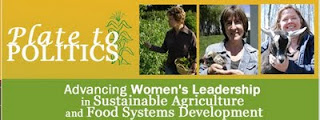
Plate to Politics - 2012


Look up "moms against" in your favorite search engine and you'll find an untold number of organizations comprised of moms against such and such. Moms Against Drunk Driving (MADD), Moms Against Mercury, Moms Against Climate Change, and (my favorite) Moms Against Sarah Palin. Moms definitely have reason for their anger and advocacy for change. And now there’s a new collaborative of moms, and not moms, that will be working to engage more women in food politics. And do we need it! Despite our efforts to shift our national food policy in a more progressive and healthful direction during the last Farm Bill, we're still getting served up more of the same. This past spring, for example, many of the progressive programs funded through the last 2007 bill such as ATTRA were eliminated and other organic programs were put on the chopping block. Fortunately, organizations such as the Organic Farming Research Foundation were able to preserve organic research funding. Despite budget cuts attacking a broad spectrum of social services such as organic food and farming research, health care reform, and education, military spending is only slated to increase in 2011 and 2012. So it was with a happy heart that I received the press release below announcing a new coalition of women who convened to discuss policy and food system reform.

What Plate to Politics posits is that women's leadership in political positions will activate change through the entirety of the food movement's various branches - labor, farm to school, consumer awareness, Native foods, organic research and practices, health, and environment. This was expressed through the diversity of attendees at their first meeting, women who represented all of these facets of our food system. It will take all of us in this movement to make headway next year and Plate to Politics is sure to be a great force in organizing rural and urban women alike around a progressive food policy platform. So visit the website and get involved!

Women from Around the US Gather in Wisconsin to Strategize Ways to Strengthen the Healthy Food and Farming Movement
A diverse group of 30 women food system leaders from across the country met May 23-25 near Racine, WI, to begin the process of creating a national strategy for strengthening the influence of women in the healthy food and farming movement, from the farmhouse to the White House.

“We called this gathering ‘Cultivate 2012,’ reflecting the fact that next year will be a pivotal year for increasing women’s leadership and voice around food issues through the next election cycle and farm bill,” says Liz Johnson, National Director Rural Leadership for The White House Project, a non-profit aiming to advance women’s leadership in all communities and sectors.

The Cultivate 2012 summit was the kickoff of Plate to Politics, a nationwide coalition of women in sustainable agriculture sponsored by The White House Project, Midwest Organic and Sustainable Education Service (MOSES), and Women, Food and Agriculture Network (WFAN).

“Women have always been the primary drivers behind the healthy food and farming movement--as farmers, purchasers of their families’ food, and staff at the non-profit organizations that support the work,” says Leigh Adcock, executive director of WFAN. “Plate to Politics is the beginning of a national coalition of women in the movement who will work on a series of projects and initiatives to magnify our voices and influence in the arena of sustainable agriculture and healthy food systems.”

Women attending the Racine gathering represented a wide range of backgrounds, such as Lydia Villanueva, a Latino farmer organizer from the Texas Panhandle, Severine von Tscharner Fleming of New York, a beginning farmer advocate and producer of the film The Greenhorns, and Aurora Conley, a tribal leader working to preserve native strains of wild rice in northern Minnesota. The group included farmers, leaders of national grassroots organizations, federal agency staff, political activists, researchers and communications professionals. Meet all of the women leaders here.

Key initiatives that emerged from the Cultivate 2012 gathering are development of:
• an authentic, positive message in the national media prioritizing the triple benefits of the movement for health, economy and food;
• a national database and social media platform for collecting and championing diverse and inspiring stories of women farmers and food activists across the country, including connecting them with opportunities to be policy leaders from the local to the federal level;
• a targeted education campaign for Congressional staff and leaders on policy issues of importance to women in sustainable agriculture;
• and an informational toolkit and resources to educate and inspire a broad diversity of voters on food issues.

“The core of our work and conversations at Wingspread was a deep and collaborative commitment to social and racial justice that drives the action agenda we developed, including perspectives from rural and urban, women of color, young women, native women, immigrant women and elders,” says Lisa Kivirist, director of the Rural Women’s Project for the Midwest Organic and Sustainable Education Service (MOSES) and author of Farmstead Chef and Ecopreneuring. “We proved at the summit that as diverse as we are, we can coalesce around several key initiatives that will support the millions of women working to change America’s food system for the better.”

Visit the Plate to Politics website to learn more about these initiatives and find out how you and your colleagues and constituents can get involved in this vital work!

Sunday, May 15, 2011

Busy Times!

With spring on its way out the door, we are quickly entering early summer mode here in Northern California. For the past few months I've been busy pickling and canning everything that I got my hands on! While last year was the "year of the book," this is the year of doing things, of growing things, of putting seasonal splendor up for next winter, and of enjoying late nights in the kitchen with friends. My canning sessions to date always seem take longer than planned and it's a sure sign that I am truly a novice at the art. For example, a few weeks ago I was up until 3:00 AM waiting for the marmalade to get to the right consistency. Sometimes things take longer than planned.

In addition to all this food work, I have two new bee hives that I'm looking after along with my boyfriend's fabulous mom up on their farm in Sonoma County. My last hives disappeared suddenly a few years ago and it's exciting to get some going again. Bees take pollen (pure sunlight) and turn it into golden honey - a wonderful alternative to cane sugar that is also said to help with allergies.

In between food preservation, beekeeping, and some Farmer Jane events here and there, I've been looking for more stories to tell on the Farmer Jane website; especially the stories of women of color. Why women of color, you ask? Because, these are the stories that aren't being told as much as they ought to be. While writing Farmer Jane, I searched and searched but unfortunately did not have the right contacts to get in touch with more women of color. (Thirty percent of the book's stories fall into this category, but it's hardly 50 percent - the goal that I had set for myself.) So if you have any contacts of women that I should reach out to, please send them my way by emailing me at info@farmerjane.org. I would very much appreciate it!